

About a year ago, I stumbled across a conversation online about how unprofessional it was for authors to review other authors’ work, and the exchange rattled me.
The conversation generally goes like this: Once you’re an author, stop reviewing books. / Yeah, they’re now your coworkers. How would you feel if someone went into your office and gave you unsolicited feedback?
I’ve spent maybe five years seriously revising my debut novel (with news incoming), but I’ve spent the last fifteen years as a book reviewer on a blog that’s been responsible for nearly everything I love about my life.
Each time I try to write about this topic, it exhausts and deflates me. I can’t possibly capture the nuance, but I do think my perspective can be helpful. Maybe you’re in the same boat and deciding where you fall or you’re concerned about the state of the arts. Maybe you vehemently disagree with me continuing to post book thoughts!
Publishing etiquette does matter.
Publishing’s a smaller industry than most expect. I’ve been around for a while and am a long-game person, and I’ve seen people burn bridges in the pursuit of short-term buzz. Reviewing is a skill too, so I’m not surprised it’s tricky.
What surprised me was the number of authors I love saying that reviewing at all was a bad look because you might want to ask a creator later for a favor. I don’t…love that norm, although I understand it.
For about a solid year after first seeing that thread, I worried about whether I’d screwed myself over by having been a public reviewer. (I still do, honestly.) The way I review has shifted slightly, but I largely think I’ve always covered books respectfully.
But of course my lens has contours that I want to express when describing my reading experience—some of which might not be 100-percent gushing by default. Does that make my notes unprofessional?
There are two aspects of this: the personal choice to review a book and then, within that, the obligation to post only positively.
Comfort levels here will vary, but the awareness of them—about there being a faction of people who view author and reader as binary identities—makes me realize the depth of my naivety in how people posted about books online. (Social posturing and niceties will always exist, but did we always have a hard-and-fast rule?)
Unfortunately, I cannot stop reviewing books.
I started my book blog in the seventh grade. 15 years ago. I just turned 28 a few days ago, so—I’ve been running Words Like Silver for over half my life, and definitely throughout the most formative years. On the first night of college, people were like, “Oh, you’re that book review girl.”
My work and personal life are so overlapped because of my blog. My journalism, my book, everything. Words Like Silver is so woven into me and my identity that I cannot picture the day I let go of it—for better and for worse. It’s a spine. I’ve been a bookseller and book club moderator and literary agency intern and all sorts of other roles within the book-related ecosystem.
Most book bloggers by now have stopped running their sites, or shifted to other, more rewarding or monetizable platforms. I only know a few other than myself who have stuck it out.
But here’s the expectation in author circles—
They’re deleting their Goodreads accounts and scrubbing reviews off the Internet. A lot have expressed that you should never ever say anything about a book that’s not ‘!!!!’
This varies by genre and ecosystem in that reviewing etiquette depends on priorities; indie authors rely so heavily on Amazon rankings influenced by numerically starred reviews, for example, so I understand the sensitivity to sales impact; litfic, IMO, is mostly based on social circles and signifiers beyond a certain veneer of style, so navigating that space involves a lot more jabbing and social posturing around a shifting definition of “taste.” Sharp rebuttals are more of a norm as people try to claim objective elevation?
I am solely in traditional publishing or “tradpub,” largely avoid BookThreads discourse, and am grateful to be an old-fashioned blogger who tends to talk about the macro views of publishing rather than individual conflicts. But there are still plenty of debut rules treated as law nowadays, book reviewing being one of them.
It’s not a new etiquette to be careful about reviewing, but the rule seems to have intensified. Before querying or going through [redacted publishing process], I considered whether I should in some way sanitize or reduce my reviews available online. Not only did I get overwhelmed by the hundreds I’d have to wade through and the history spanning them (my thoughts since age 13, preserved), but I just couldn’t imagine shortcutting my blog evolution.
For me, it felt like too inauthentic of a maneuver. Unfortunately, I’m very “what you see is what you get” in that I’m bad at being knowingly false. I’d call that honesty, but I’m also not saying that people hiding reviews or choosing not to share them are being dishonest in contrast.
There’s a whole lot of emphasis on platform-building now too, and most of my online presence is built on book recs and conversations anyway. Erasing them would even negate what the publishers love.
My reviewing style matters in this conversation.
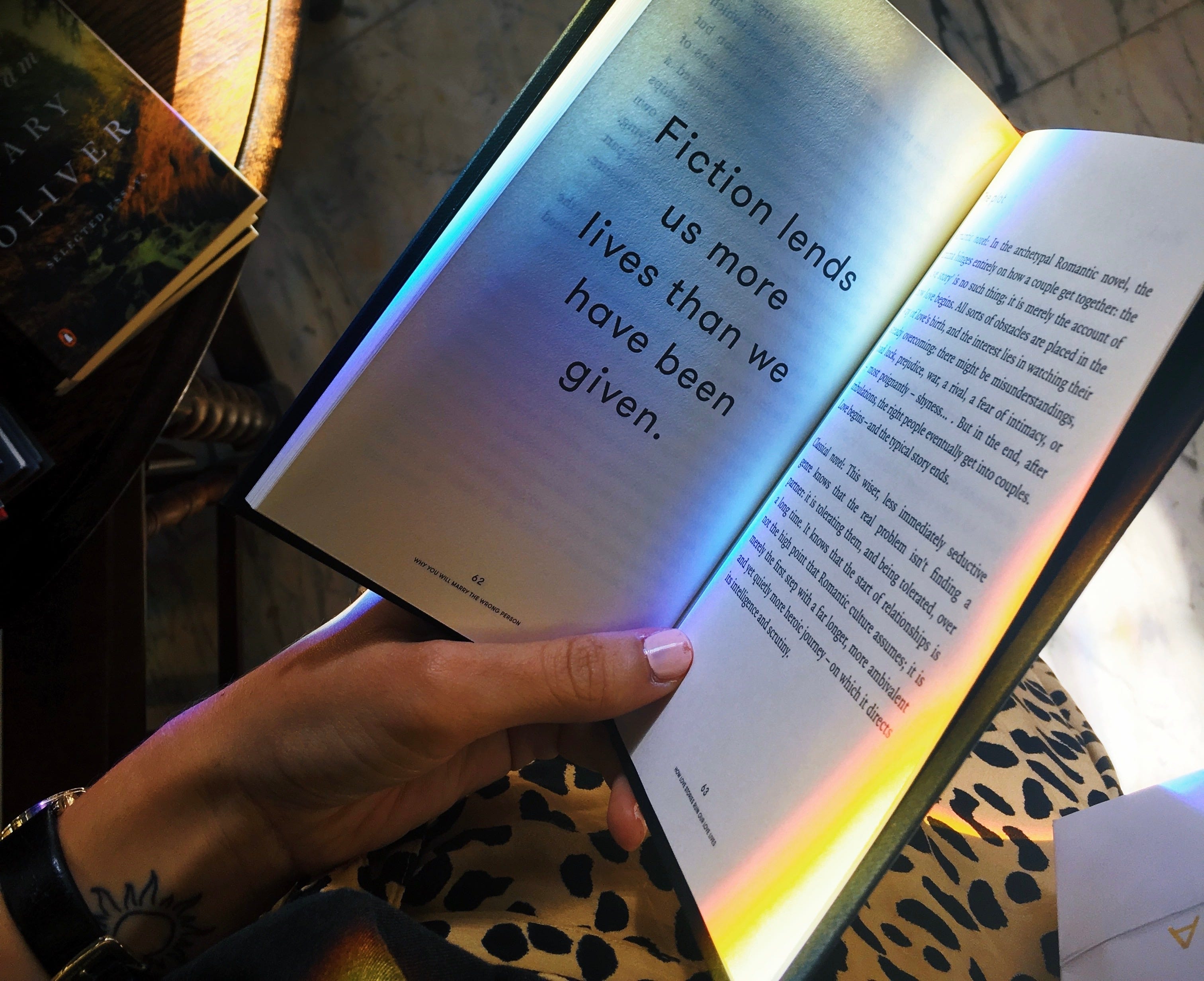
Each reviewer writes differently and I obviously like my style or else I wouldn’t execute it. My reviews tend to be more “reflections” or “book club-style.”
My reading preferences impact my review structure too. I tend to discuss craft when writing my reviews—touching on prose, pacing, etc.—so dissect it even in books I deeply love. (Sometimes, a review is just enthusiastic about the experience, but I love analyzing specific moments.) My reviews are also informed by several years of writing service content for traditional journalism outlets.
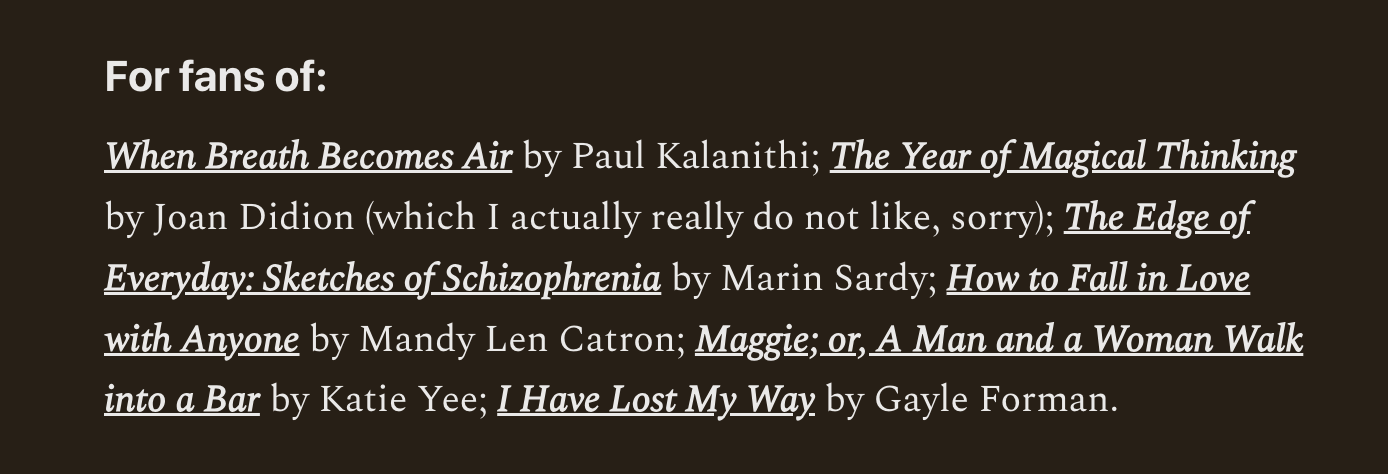
When I don’t fully connect to a book, I usually have a fans of section or qualify what about a given book didn’t land for me, which then has the added effect of specifying a crowd that book would most appeal to.
Being able to distinguish when a book is “bad” vs. “not for you” is a skill, and phrasing matters. If you can’t write a negative-ish review well, you may just not be good at writing reviews! Which is perfectly fine too. You can record your book thoughts however you’d like; it depends on your purpose. I’d like to point even the books that weren’t for me to the right readers for them.
And then there’s deciding what to review. I read 150+ books a year, but review maybe fifty or sixty. I can’t possibly get to every book, which means the choice of coverage at all also carries weight in this conversation. Some people might say a solution is to only review wholly positive books; others are scrubbing their profiles because they gained traction by writing clicky takedowns.
Part of why I’ve added a Why I Picked It Up section is even to specify the subjectivity of how I sit down with a book, and what generosity I have towards it because that will impact my perception of just about everything. So it feels impossible for me not to be specific in my experience of a book when I’m approaching reading a given work as a two-pronged experience: there’s what the book seems to be, and then there’s what I bring to it.
“Only give books five stars.”
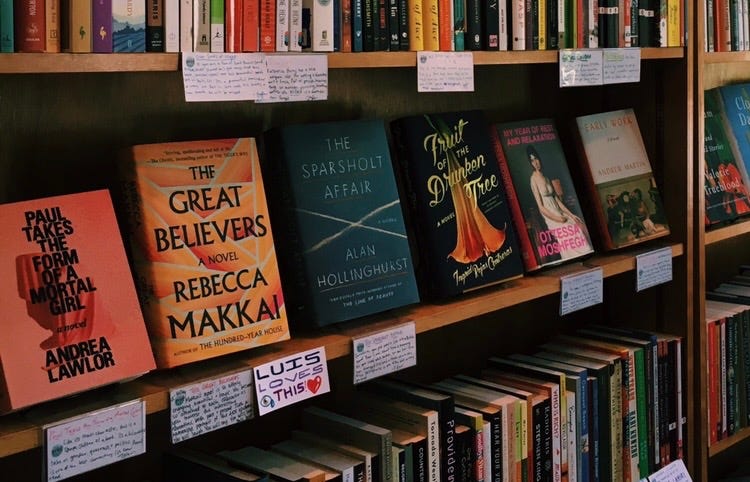
A lot of the conversation around authors reviewing books is “Only review five-star books,” which is reasonable. Plenty of publications use a best of format for reviewing because they rely on affiliate income anyway, but then you get boxed into a more listicle-type structure.
I occasionally hear “I give every book five stars because I know how hard it is to write one,” which to me is not a standard we should hold ourselves to. (I think that respect and admiration should already be assumed, so that argument holds no weight for me personally. Otherwise, why review a book at all?)
But I don’t love the five-stars solution for myself for a few reasons:
A lot of the people saying this then go on to rate most books they read five stars, which I simply don’t believe. I know my taste well enough that I generally like most books I read, but I still think calling every book “best book ever” dilutes the impact of an endorsement.
Some people read way less or more narrowly than I do, which could also account for most of their books being “five stars.” Because I explore so heavily outside my usual genre/voice/author cluster, it takes some guess-and-check within new avenues to figure out what’s for me.
Sometimes five-star books are the ones I can analyze least. It is a good thing, usually, if a book makes my brain go blank.
I analyze many of my favorite books even when I love them. No review I write is ever entirely 110% positive and glowing and perfect to an author. Creative choices are, by nature, subjective in how their execution lands for individuals. (I know this as a gal who flinches and hates my life whenever someone tells me my book was “very good” or similar; I am aiming for absolute obsession and any sort of anything less than that will kill me regardless. But that’s not a reviewer’s problem; that’s my own perfectionism.) Many books are favorites of mine for their “imperfections”—risks that take voice and guts and decisiveness.
My favorites shift and change with time, distance, positioning, mood, etc. which is why I believe in specifying the pros and cons of a given book for a particular reader experience. There are some books I loved in the moment but a year later, I realize I don’t ever think about. There are books that have more mixed qualities, or I didn’t particularly enjoy reading, that stain my associations and references in a way that makes me realize they were formative. So it’s not as simple as “star rating” for me. I need the paragraphs to flesh out how a book situates itself within my brain.
Star ratings matter a lot more because of the algorithms, so I get it. Certain genres award stars differently (and nobody can agree on what a three-star read means anyway. Each scale shifts.) It does work in technicality as a boost that won’t offend the professional ecosystem.
There are also problems with content incentives baked into the platforms themselves (another reason why I think everyone should read Superbloom by Nicholas Carr):
As many book creators have realized across platforms, negative headlines get more clicks than positive ones. I tend to keep it simple with my Book Title by Author — Review + Discussion format on here rather than going for something splashy, but would have shifted that if I cared more about baiting traffic. Your hatred of a peer’s work will probably end up being more visible than your praise.
People often complain that spaces like BookTok and Substack recommend all the same titles or seem to flatten into this mono-taste (on various sides from litfic to romantasy), and the reasoning is algorithmic and often unconscious too: because those videos, reviews, etc. talking about buzzy books get picked up in the traffic. Then buzz feeds buzz.
Nowadays, more BookTokers and similarly massive book creators (which occupy their own niche) do it full time via sponcon from publishers and brands. I’ve even seen them say that they don’t feel like they can be honest about a book because it affects their paycheck. To me, I don’t really get the appeal of being a “reviewer” then? But in fairness, I’m ironing out the same financial worries of authorship (arts vs. security), so I get it.
I like to think I’ve been grandfathered into book reviewing.
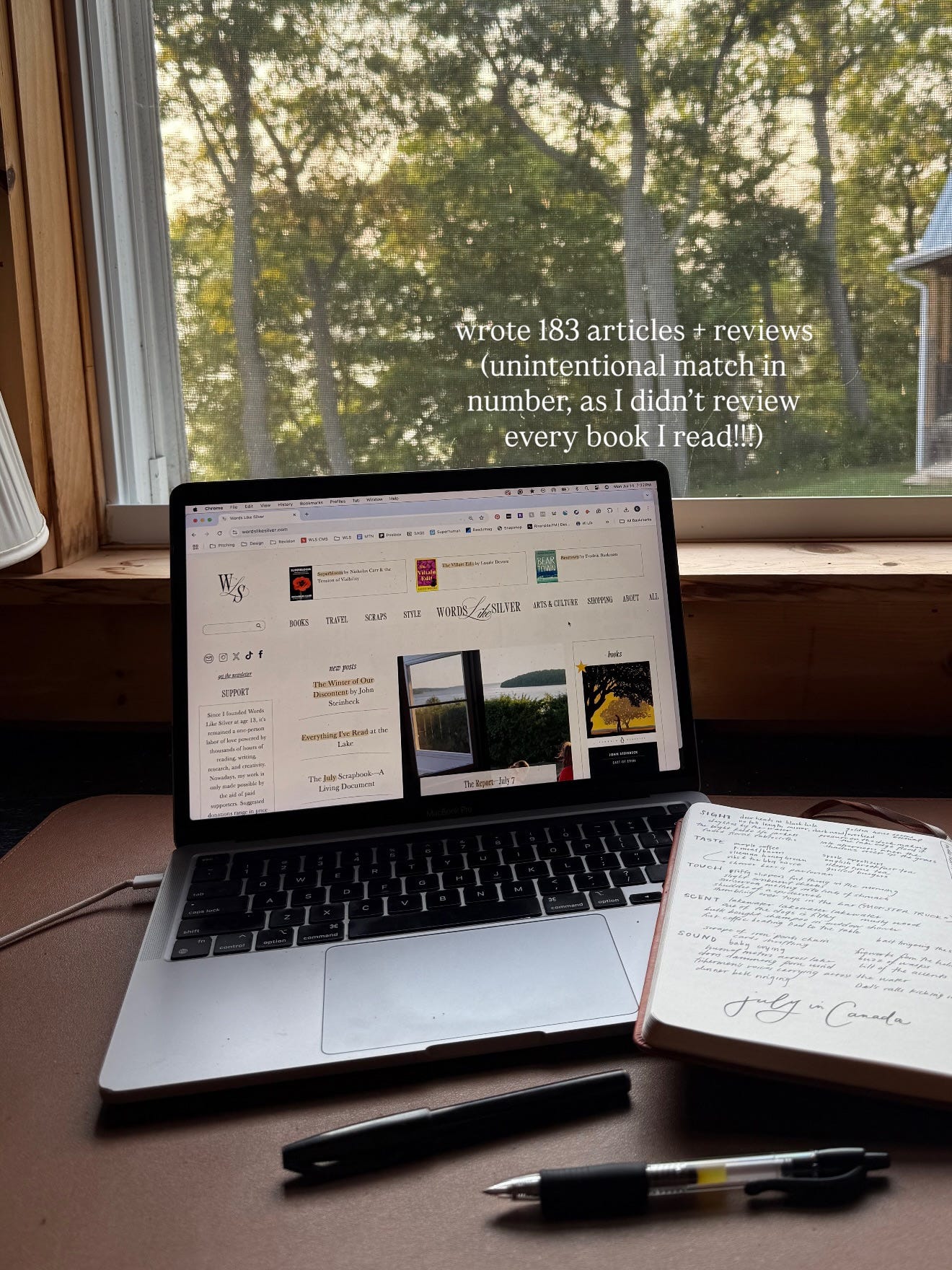
I didn’t grow up on this etiquette. I’m sure it existed in a plainer sense then, but the way it’s treated now is in this stringent, shocked, horrified way (a broader population of visible authors doing self-marketing online? Rating systems? Attention economy intensification?) so it doesn’t feel the same as when I was fifteen.
By now, the reviewer instinct is metabolized in me and I love it. Luckily, I do think we exempt professional journalists, to a certain extent, and plenty of my work for magazines falls under that category. There are many authors who started as reviewers for PW, Kirkus, SLJ, etc. and we don’t call them unprofessional. We let them cross over no problem.
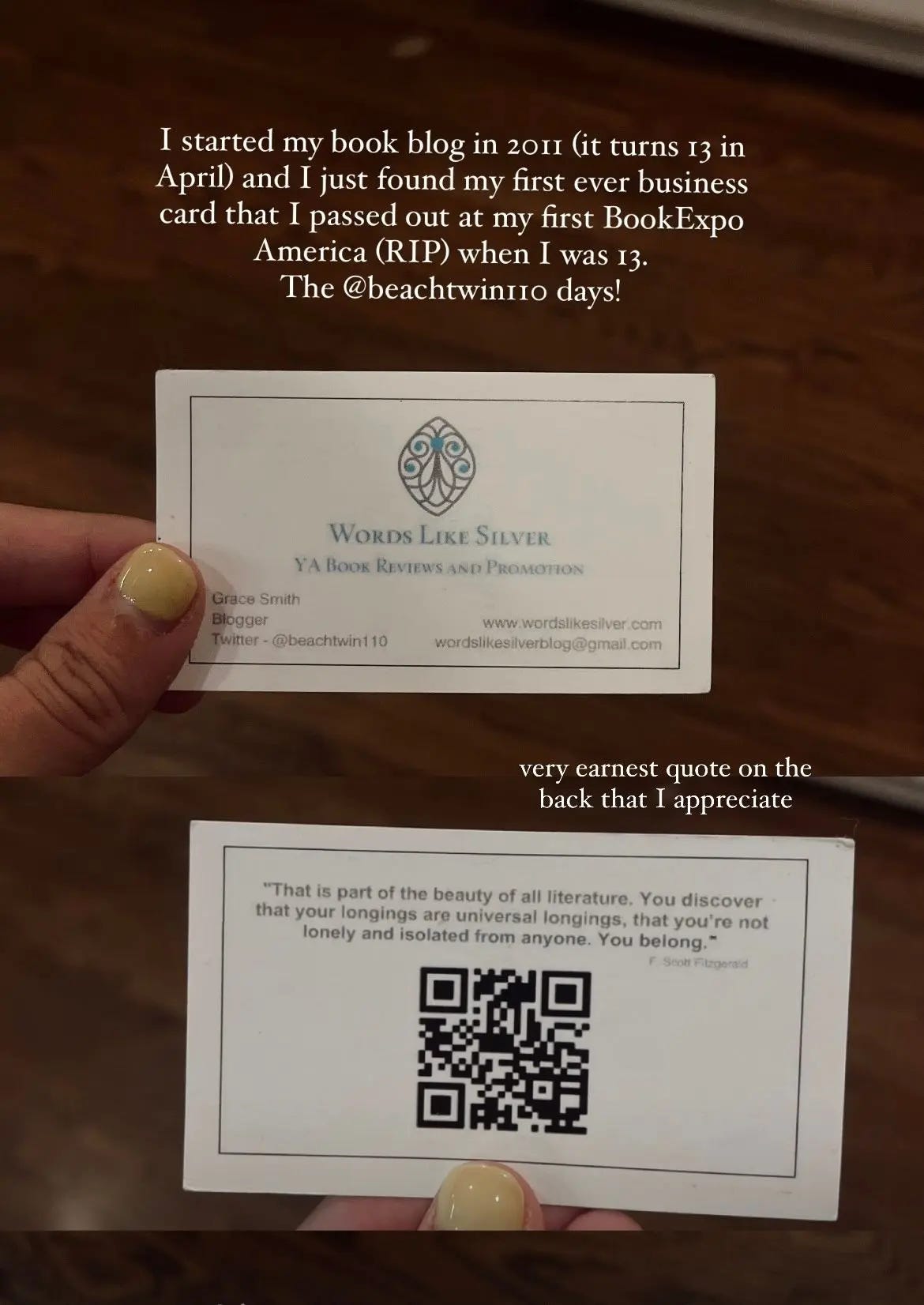
I think for the most part I should be able to say “I’ve been writing book reviews for fifteen years, both professionally and non-” and people will give me a pass. But I also believe authors as a whole should be able to share book thoughts honestly without justification, and shifting in that direction would be net-positive because then we wouldn’t default to viewing authors-discussing-books as invasive or too personal.
What happened to critique culture in the arts?
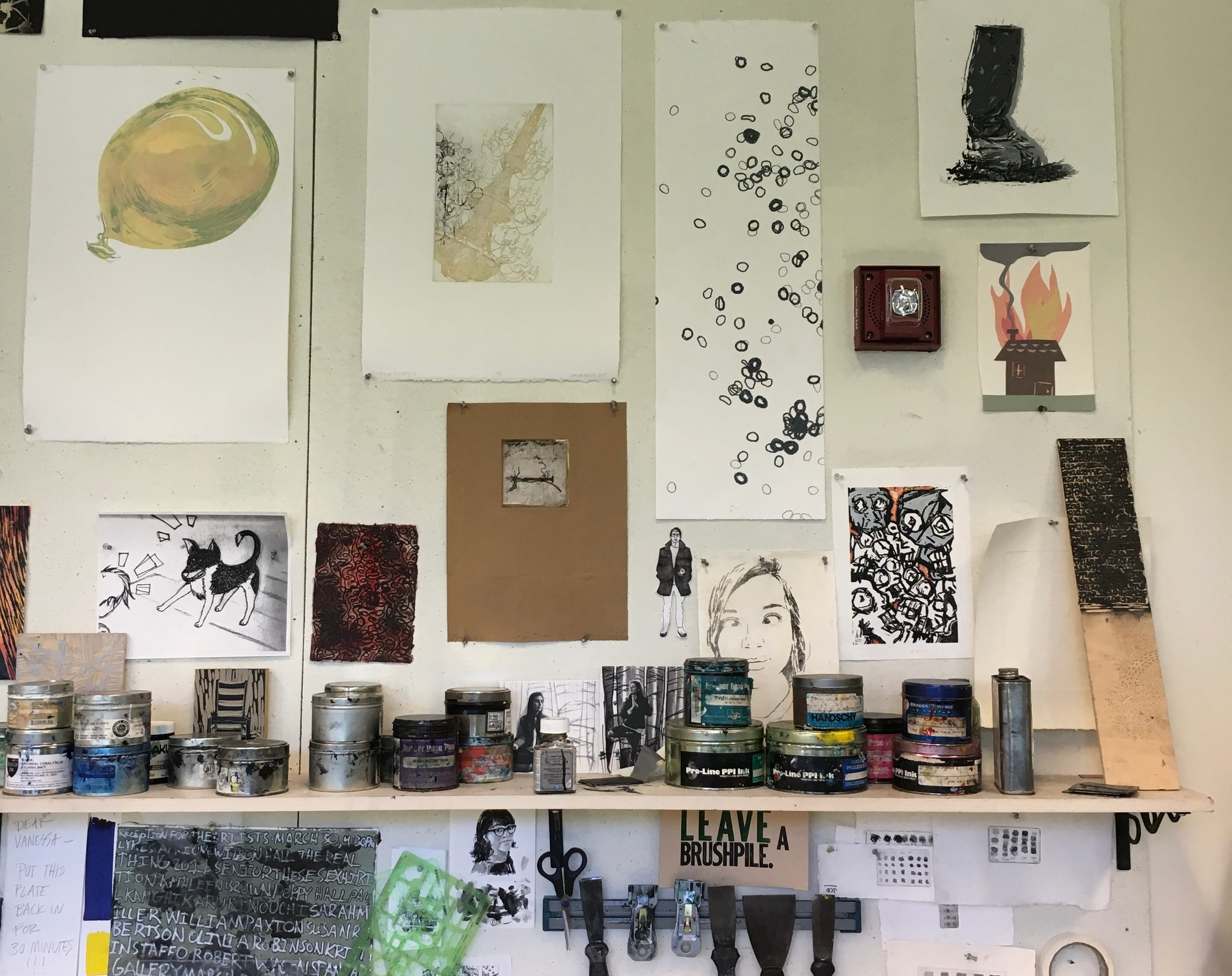
Within the arts and academic world, I grew up in a studio art background that invited critique, and critique was a skill you honed throughout workshops: how to take it and to give it—what was understanding, concrete, a line between the subjective and objective. Even acknowledgement of where it blurred.
I understand the need within book publishing to show solidarity with your peers however you can, and I’ll gladly support other authors however I’m able. But to me, support and my subjective opinion of a book should be allowed to be separate spheres.
There’s always going to be a little bleed, but it’s up to you (the receiver) to be able to de-personalize the impossibility of being 100-percent for-everyone. And Lord knows I will go to bat for the books I adore.
There is a lot to consider in how we’ve scraped down the arts as a category enough that art is also content is also product, so that emphasizes why any sort of not-effusive feedback can feel like an existential threat to a creator. Anything less than 100-percent is negative.
I get it entirely and empathize. We’re in an economy that is systemically devaluing the arts, and I frequently say that nearly every creative you meet online is there mostly because we need attention for funding, and funding so that we have the time to create in the first place.
Most people, if given the option, would likely opt out of this degree of visibility, which means that shaping their “brand” or reputation (which ripples into caring so much about reviews) does feel more crucial to making a living. So I get why hearing any peer whatsoever talk about your work in a way that doesn’t meet your standard of approval might feel like they’re intruding on you in a way you didn’t ask for. The algorithm will probably show you whenever someone talks about your book because it wants to keep its emotional hooks in you.
On one hand, we signed up for this exposure by creating something subjective at all; on the other, in this current economy, few authors really have the choice to steer clear entirely and go hermit mode, so it makes sense to avoid making the Internet more painful than it needs to be.
The truth for me is that I enjoy reviewing and recommending books to the extent that being restricted in any way from being honest about my peers’ work just makes me less likely to choose to read it. I don’t want to resent having to keep my opinions secret, especially since most of mine are actually very positive overall. Quality attention towards a book is probably not entirely positive or negative; the subtlety and nuances of a given work will hit each reader differently, and a book’s specificity is what I love to highlight. “Take it to the group chat.” No. The problem is that few reviews of mine will ever hit that 100-percent threshold of being perfectly pleasing.
While I keep plenty private and offline, I take pride in being the same person across platforms and media. What you see is what you get. I’m not going to consciously shape my online presence differently, and that might just be a limitation of mine. Unfortunately, that extends to people asking me about books because it’s such a huge part of who I am? I feel perfectly justified saying something “wasn’t for me, but might appeal to [x] type of reader.” That’s why people trust my taste, regardless of whether or not they share it.
But I’ve been relatively transparent about how, last year, part of the reason I picked so many older books to read (beyond the intellectual clout on Substack) was that I could dissect them freely without 1) making market comparisons or 2) worrying decision-makers would hold them against me when evaluating my book.
At this point, I’ve reviewed books by every major publisher and probably most imprints, and I can’t go through 500 or so reviews to determine the language in each wouldn’t offend someone in acquisitions. It was easier to just go for classics, philosophy, sciences, and other genres that were not the ones in which I was writing. But it’s unfortunate to think that I could have any black marks against me for my reviewing history, which is extensive.
Ultimately: I’m probably too specific in my description to please this rule, which is why I don’t like it. My voice relies on precision, which is why I feel restricted by takes asking me to not be specific just because those thoughts or examples could be taken as negative by another author.
A short, good example: Maggie Stiefvater reviewing Jennifer Donnelly
For the record, I’m a huge Maggie Stiefvater fangirl. Several of her books are favorites of mine, and I love her craft newsletter Telltale Crumbs from Maggie Stiefvater. Many authors basically want to be her, myself included. There are some of her books I don’t love quite as much as the favorites either.
So I’ve always respected her review of Revolution by Jennifer Donnelly, another all-time favorite of mine that also, as she puts it, “has many layers to pick at” because it is so great.
If she had been constrained from posting this review, I might not trust her taste so entirely. IMO, this is a brilliant and positive review that also acknowledges the very real pushback authors feel about reviewing those they’d want to befriend. And I think it’s wholly respectful. In light of this review, I respect Stiefvater’s craft more than the author who keeps reading analysis to themselves, although of course that is their right to redact. And I want to be like her in that vein.
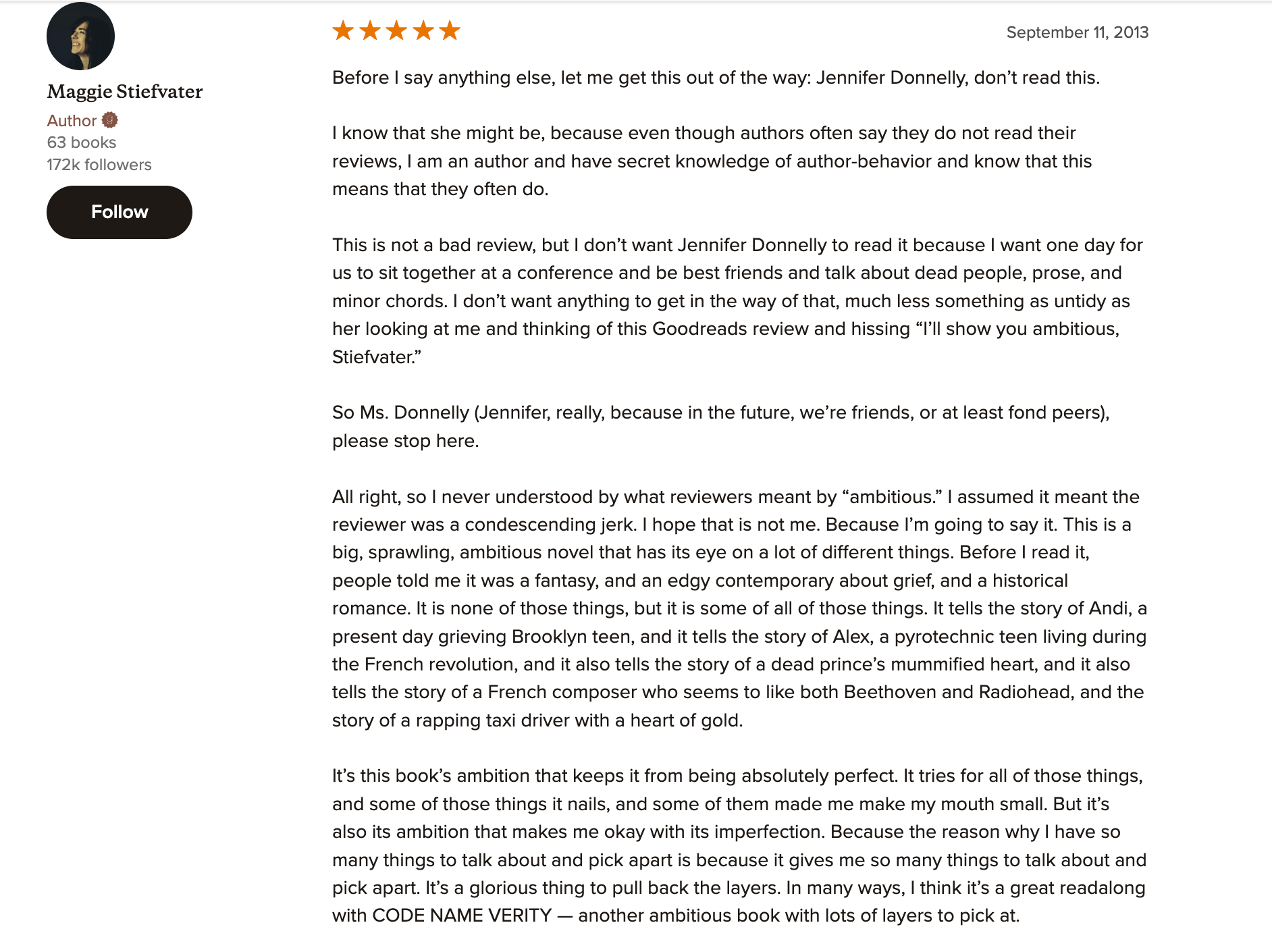
As Maggie Stiefvater puts it in her review,
What else do I want to say about this book? Because I want you to pick it up — I want everyone to. I want writers to, because I think it will make them better writers, and I want readers to, because I think it will make them better readers. I want everyone to, so I can have someone to talk about the cleverness of it, right down to the title.
Maybe Maggie Stiefvater was allowed to write this review because it was a different era, or she was already great. We didn’t have the same rules then. Maybe she is exempt. But I would like whatever she has, please, because she is spot on with the feeling of needing to review the book you love.
My main issue tends to be with how we’ve drawn a “professional” line over the social ones.
The defensive argument that “authors shouldn’t review” mostly rests on a binary argument: you are a reader and then, when you cross into being author, you are no longer one. It is somehow a graduated state.
The language online uses bits like coworkers and peers and the office metaphor. Visibility is a scarce resource because we’re fighting within the attention economy; authors have also behaved badly on the review-bombing front before by making fake Goodreads accounts to tank other debuts’ ratings (see: Cait Corrain); a rising tide lifts all boats; etc.
But most of the time when I read this “don’t review as an author” argument, it inevitably boils down to: you don’t want to push away someone who can do a favor for you.
Now, I completely understand this validity. Networking, as many people have said this week while talking about Lost Lambs, is integral to the work and the marketing and the love and terror of an artistic career. It is a skill and requirement. To do the work, you need to care about what lets you do the work, which is why the reviewing element causes me such agony and confusion now.
It’s deeply fun to be in a landscape of creative people passionate about books. People coaxing or burying positive and negative reviews in turn has always been a thing, and your voice as an author holds weight.
But people have preferences, tendencies, and voices—and readers connect differently to each of those touchpoints.
If I respect an author and want to see them succeed but don’t love their work, I’m still likely to praise what I admire! I might hail a quality like the obvious research and consideration or something related to the work ethic or the specific flavor of their voice. That’s a genuine way to support a narrative without pretending their book automatically checks all of my reader-preference boxes, and that’s why I would prefer the ability to be precise and wordy within my reviews without being dinged for it.
I talk so much about salience and generosity being crucial to the writing process. If I’m reading a book by someone I like, I’m also probably more likely to approach the book with an open mind seeking grippy aspects of the story to love.
So my review is probably going to be nicer even if I’m clear about the taste in some way being off-kilter to mine. I probably found something to enjoy.
Even on here: I adore many of y’all, but there are some people I dread reading my book because I just don’t think they’ll love it as much as I want them to based on their established taste. I would love them to be surprised. I would love everyone to be kind and thoughtful and buy it anyway. (I do think it will cast a wide net and have broad appeal and and and!!!!) But I’m not offended by my book not being perfectly calibrated to everyone. Percentages will vary.
To me, just…I think there’s a graceful way to give honest opinions on subjective art forms and I try to do that. Unintentionally or not, it just feels manipulative to only engineer the landscape of reading and reviewing for transactional purposes. Maybe that’s part of the machine, but that POV maybe ruins some of what makes the ecosystem special to me in the first place. The way the advice is phrased usually comes across to me as shockingly social climb-y. Something like:
“Don’t review that book unless it’s glowing because so-and-so could get you an invite to this panel.” Or similar.
Sure, you can decide not to ever say something about a book because that person could pop off and gain 10,000 followers and hit the NYT list and blurb your book if you hold your tongue. (Plenty of authors who hit their stride in later books discuss their prior treatment and how people changed.)
I think you should be welcoming to everyone and not snobby about where someone starts out, so you should treat everyone well regardless of their social circle, location, prestige markers, deal size, genre—whatever arbitrary qualities you’re using in this example to decide “this author could be helpful to me someday.” In a perfect world (or in how I operate), that knowledge shouldn’t even affect your behavior so you would give the same opinion regardless.
Of course, PR is an embedded part of everything, and that includes social graces! But there’s a line where measuring this just becomes straight-up transactionalism, and in my experience, the reviewing conversation is usually lands on that side of the line.
If you follow this mindset then say how much you love my book in your next breath: you have to understand my skepticism. I believe reviewers more with a grain of salt or if they’ve expressed their map of taste in the past. Not that there is something negative about every reading experience by any means, but the uniformity of book praise by authors can start to feel monotone and therefore meaningless.
Plus, people switch up publishers, agents, styles, genres, etc. all the time. That’s often the reason people warn you not to touch reviews—because you could eventually be in their circuit, even if you think you’re too distant to matter. To me, this phenomenon actually proves the opposite: that because publishing is warping and always changing, we should better understand that book reviews and opinions are subjective snapshots, not a reason to hate the person who holds an opinion you didn’t like.
I just hope I never start looking at other authors solely through the lens of potential favors, and that’s my own choice. Maybe that will affect me, but I hope someone is capable of identifying where they fit within my taste without de facto resenting me for expressing the map. My reviews often bounce off of other books because my entire library lives in conversation.
Pickup Artist: The Pitt, The Plague, and Peter Matthiessen

In the last almost-15 years of running my book review blog, I’ve collected quite a few references. When apparently not in the all-consuming funnel of a book revision, my thoughts pinball all over the place to books and studies, which sounds rather obnoxious but is just the way it goes. It makes living in my head sometimes feel like this:
If reviewing isn’t a core part of who you are, it’s okay to let it go. Unfortunately: it’s also kind of my life’s mission at this point. The right book at the right time emphasis I’ve had lately.
So I see reviews as calibration.
I do not think it’s unprofessional to write negative reviews. I don’t think negative reviews are bad; in fact, I think they’re crucial. But I understand why many authors avoid doing it.
It is a-okay to keep your cards close to your chest (especially while debuting because none of us know what the hell we’re doing), but so much of the reading and writing process—in my view—involves a calibration of taste. There are a few reviewers I swear by (like Iyana) because they’re straightforward and lovely: generous, but not dishonest.
It’s a simple give-and-take to others too. If you don’t write real reviews or give genuine opinions, I won’t trust your book recs and that’s fine. Having a professional veneer or packaging in various contexts is also different than being straight-up fake. If you give vastly divergent opinions online vs. offline, I might view it as slightly two-sided. People operate using different codes.
Reviewing is not necessarily as built-in for others as it is for me, but I couldn’t escape it if I tried.
And I do think part of why people trust my book recs so much and why my moderate blog following actually has intense sway over what people read (obnoxious to say, sorry) is because I’m also willing to share the negative aspects of what I choose to read and love. Again, articulation is a skill and also the point.
Personally, I’m passionate about the mission of getting the right reader to their right book, and I’ve been proud of how much that specific goal has resonated with those who have stumbled across Words Like Silver in the last year. I read widely, but I can pick Dostoevsky or Fredrik Backman or Jennifer Lynn Barnes or Toni Morrison depending on the reader and situation, sommelier-style. Not every book should go to every person, but that doesn’t mean that book is bad. Just that there is a perfect fit, a great fit, a good fit, etc. etc.
Plus, we’re in a reading crisis, and most people aren’t picking up many books anyway. If someone is only reading five books a year but would read more if each of those knocked it out of the park, I do feel a moral responsibility to try to get them to those mind-blowing reads that will boost their habit. That includes steering them away from titles I don’t think are what they’re looking for. Maybe it shouldn’t be my job, but I don’t think being an author now excludes me from it.
You just have to get someone from 0 to 1 book.

There’s a whole conversation going on right now about whether it’s better to position reading as a vice or a virtue and what will ultimately motivate people to pick up a book.
So where does that leave me?
For the most part, I haven’t changed. I never did numbered star ratings in the first place—there was maybe a year of doing them on Instagram—and rely on the essay-like text to do my reviewing. My hatred of Amazon kept me from reviewing there or on Goodreads, so I’m not participating in the algorithmic levers that people get so upset about. If I’m crossing a line, I’m sure my team will yell at me.
But part of the love of Words Like Silver is that I absolutely relish “book club”-ing a given book and love talking about individual creative choices. The nature of a creative choice is that one aspect that I love and worship will be one that you weren’t impressed by. And that doesn’t make either of us wrong?
My only real threat in reviewing is that an author I might eventually want a blurb or opportunity from discovers that they don’t like something I said about their work. But again—that’s not a good enough reason for me, based on my values?
If I thought in any way like my critique was ever cruel, personal, unfair, etc. then I wouldn’t post it. I care too much about generally being nice, and don’t think my reviewing is an objective enough lens to surpass my gut instinct for what is the way to talk about others. Plus, I’m mostly going to pick to spotlight what and who I love. (There is not enough time otherwise.) There is just a lot of honesty in each review, and that could land poorly depending on what a given author is hoping to hear—even on non-judgmental qualities like how I describe tone or overarching feeling.
I suppose I get the instinct to hold reviews against people, but that’s where I suspect I’m just wired a little differently, and why I was so shocked by the “stop reviewing” conversation.
If someone didn’t like my work, again, I’d be bummed and offended, but I wouldn’t take it all that personally. I’ll for sure internalize negatives over positives and feel a little stung towards you at first (the natural instinct), but also: that’s your right? Reading is subjective? Especially since I think it’s silly to expect everyone’s taste to be the same as mine.
If I acknowledge we have different reading tastes and writing styles, it’s natural that you’re maybe not gushing over my book the way that I would, and I won’t hold that against you. (Of course, I hope you love it.)
That has nothing to do with whether I will feel inclined to review your next book, recommend you for a panel (if I’m ever in that position, etc. etc.)
Because I value reviewing so highly, I want to always let it be real. If I think the work is good and you’ve done something wonderful, it doesn’t need to go in both directions. Just because I love your creation doesn’t mean you have to love mine. Creative love is not inherently two-way.
Relatedly, authors shift and every book is different! There’s an author whose first book I didn’t like, but whose next book I absolutely went to bat for. One opinion does not mean anything. A book review is a singular snapshot of someone’s experience with a book in time, and we need to let it be that. Be reasonable about what is a fair assessment.
Similarly, we use the phrase “reading is subjective” all the time when talking about why agents, editors, etc. might reject a given work. So let it be subjective for others also? You’re not calling those agents or editors unprofessional. You’re still probably going to submit work to them in round two.
(Of course, we’re talking about public vs. private feedback, but I think the ability to not internalize that feedback also matters when navigating relationships with reviewers on the Internet. I’m not sure why we’ve added in another roadblock here.)
Book publishing is a precarious landscape, and it is generally safer to opt towards not rocking the boat in any way that could be perceived as impolite. There is a lot of terror baked into the desire to break out within it, and perhaps I’m lucky in feeling (more) able to flirt with the risk here vs. someone else. (Or unlucky—maybe it’ll come back to bite me! Time will tell!)
Nowadays, I find myself avoiding reviewing books I might use as comp titles just to avoid any perception of taintedness. If my review already exists, I’m not going to scrub it. I’m reading books published that run in a similar vein to mine, I won’t review them if I think they’ve spiked personal feelings related to my own work. I also probably won’t say if I hate a book from my own teams; that’s probably my one “too close to home” moment. It’s a gut feeling, but that’s why reviewing is a skill you develop over time.
I did request that my website developer add a “starred” books option, meaning that I’ll toggle a star to appear on many of my favorites. Some days, I’ll randomly add or remove a star depending on my preferences as I’m doing website maintenance. I took that from Kirkus and Michelin, and I think that’s perfectly effective for elevating a “best of” within Words Like Silver.
But I think so much of the process of authorship already involves taking what you love and discarding what you don’t like from the books you read then metabolizing those preferences and rhythms within your own process (which is also why I think it’s wild that some authors say they “don’t read that much.” I trust authors who read!)
Overall, I think it’s silly to pretend like we don’t each have subjective opinions even after the book deal.
Again, you can choose not to review anything. But I can choose whether or not I believe your reviews, and I don’t think we need to moralize reviewing as an author in the way I’ve been seeing.
In fairness, that ship has probably already sailed for me, so maybe it’s over and this is pointlessly defensive. Publicists, agents, editors, whoever—plenty of the people I grew up working with have been engaging with me for long enough already that they’ve already seen me review plenty of books and authors without accommodating this POV.
I’d love thoughts, feel free to shift me one way or another, etc. etc. Very much something I’m still ironing my way through as I’m still learning the author landscape, and I’ve heard some excellent perspectives on this one as it does inevitably feel personal. But my blog—and how I run it—is one of my major loves, and this is where’s where I’ve landed for now.