

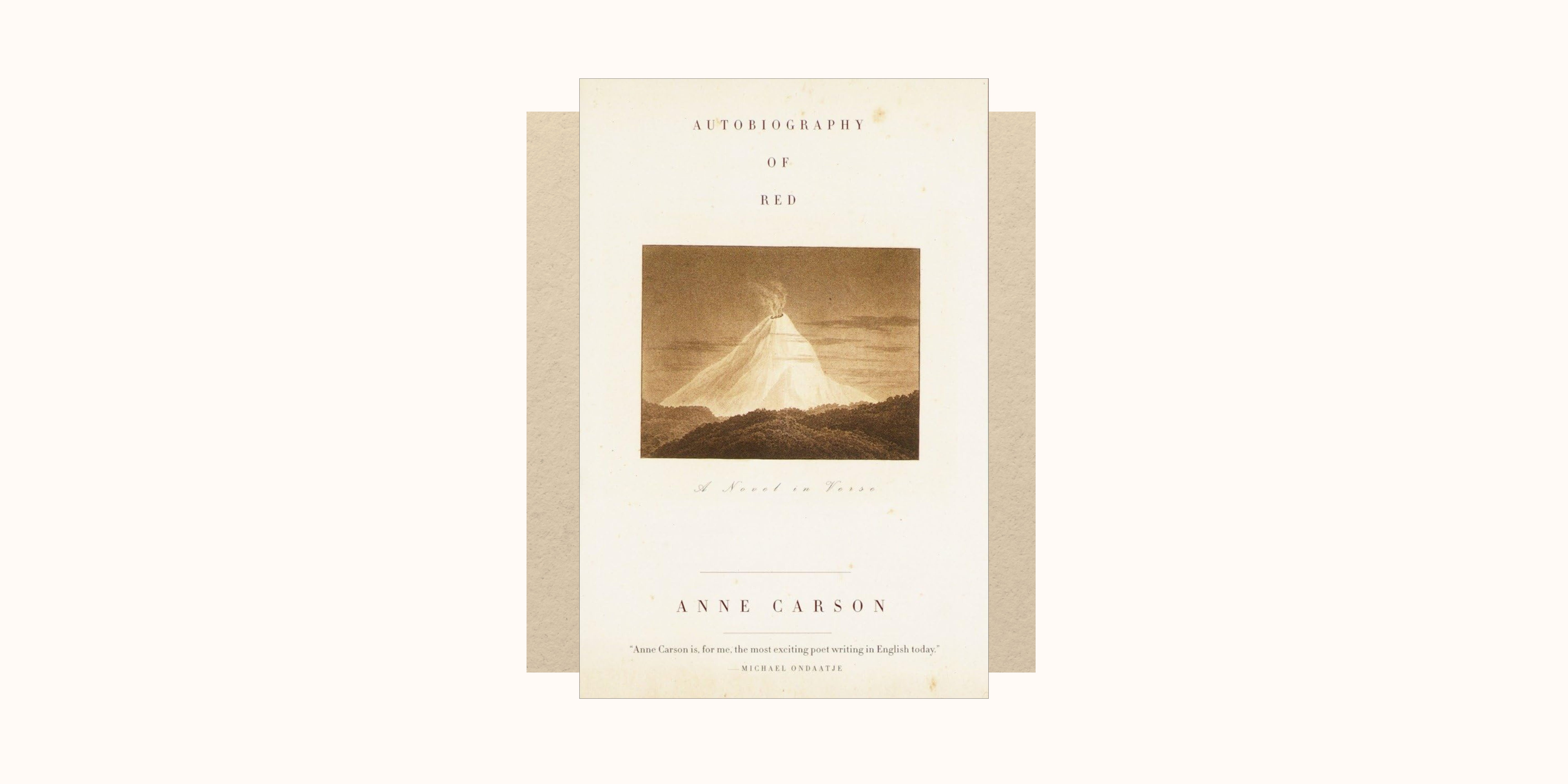
Book: Autobiography of Red by Anne Carson
Release Date: March 31, 1998
Publisher: Vintage Books
Format: Paperback
Source: Bought
Posted: November 30, 2024
To see this book review in its full visual glory, read it on the book blog I’ve been running since 2011. (I know—how vintage!) Still, I’m glad you’re reading in any format, so the full text is below:
The award-winning poet reinvents a genre in a stunning work that is both a novel and a poem, both an unconventional re-creation of an ancient Greek myth and a wholly original coming-of-age story set in the present.
Geryon, a young boy who is also a winged red monster, reveals the volcanic terrain of his fragile, tormented soul in an autobiography he begins at the age of five. As he grows older, Geryon escapes his abusive brother and affectionate but ineffectual mother, finding solace behind the lens of his camera and in the arms of a young man named Herakles, a cavalier drifter who leaves him at the peak of infatuation. When Herakles reappears years later, Geryon confronts again the pain of his desire and embarks on a journey that will unleash his creative imagination to its fullest extent.
By turns whimsical and haunting, erudite and accessible, richly layered and deceptively simple, Autobiography of Red is a profoundly moving portrait of an artist coming to terms with the fantastic accident of who he is.
Why Did I Read This Book?
When I was in college, I started as an English major. In fact, I was maybe one class away from graduating with a creative writing minor once I switched to history. I had to take a seminar class on poetry with a professor I adored, Professor Wheeler, and we read Autobiography of Red.
The class itself was phenomenal and we read some amazing work. Autobiography of Red fit my taste entirely too. It’s frankly gorgeous, pulls from mythology in a highly creative and inventive way, and is stunning in terms of poignancy and nostalgia.
I think a lot about synesthesia, and I got to write an essay incorporating some of my favorite topics—like literary synesthesia (as a mechanism) versus physiological synesthesia, and how we could determine from the passage which was which. Whether they flattened together enough that the definition itself ceased to matter. To date, that essay is probably my favorite piece of academic writing and research I’ve ever produced—and it even got awarded.

Now that I know more about neuroaesthetics and how that framework impacts my reading, writing, and curiosity, the intersection naturally makes a lot of sense to me. I pulled in the mind-body problem, the mental satisfaction of multiple “layered” senses, the impossibility of capturing a full experience in language. Hindsight bias, baby!
All in all, I’m extremely grateful to have read—nearly mistyped “red,” a slip—this book and consider it one of the Greats. It’s the quintessential Grace book in understanding what I think about, connect to, and what language I prefer.